It would be remiss of any music blog NOT to mark the passing of Cynthia Robinson, co-vocalist and trumpet player in Sly and the Family Stone.
Sly and the Family Stone were one of the first (and only) truly integrated and egalitarian bands to ever exist. They integrated male and female members, people of different races, and made some of the most vibrant and joyous music ever, at the height of the Woodstock era when there the Vietnam War was sapping everybody's faith in humanity.
Cynthia was at the forefront of this, sharing lead vocals with Sly Stone on many of their tracks, such as "I Want To Take You Higher", "Dance to the Music" and "Sing a Simple Song". She was the one exhorting us all do dance or, if you didn't feel like then "All the squares go home!"
She was also a formidable instrumentalist. Her trumpet solo on "I Want to Take You Higher" is a thing of beauty.
After 1970 Sly Stone became heavily addicted to various substances and the music became quite dark at times, however Cynthia's contributions never diminished. After the band imploded in 1975 she went on to play for former Family Stone member Larry Graham's Graham Central Station and with George Clinton.
Her contribution is underrated and deserves more attention. Vale Cynthia, you will be missed.

Showing posts with label Funk. Show all posts
Showing posts with label Funk. Show all posts
Thursday, 26 November 2015

Tuesday, 3 March 2015
Bootsy's Rubber Band: "Psychoticbumpschool"
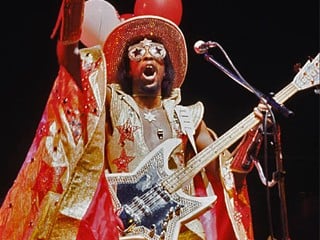
Further to the recent P-Funk post, I thought I'd post a video of one of the many classic tracks that are associated with the massive conglomerate that was the George Clinton empire, otherwise known as the "Parliafunkamadelicment Thang".
The reason I call P-Funk an "empire" or, more specifically, a "conglomerate", is because the actual structure of the band became very convoluted due to a number of legal problems and contractual issues that plagued the band. For example, in the 1960s, the band that George Clinton started as the Parliaments, became just Parliament by 1969. They made one flop album called "Osmium" for the Invictus label, before George wanted to leave and join another label. Invictus prohibited them doing so, so they changed the name of the band to Funkadelic and started making records for Westbound.
The legal wrangling ended in 1974 and George reclaimed the name, so he started making records with the same Funkadelic personnel, under the name of Parliament for Casablanca records, with a softer, more radio friendly sound than the harder-rocking psychedelic sound of Funkadelic. The same band recorded under both names with rotating memberships and with a different sound on both albums. As a touring entity, the band were billed as Parliament-Funkadelic and colloquially known as P-Funk.
By the mid 1970s, the band's membership swelled to as many was 20 players, with some members (including guitar whiz Eddie Hazel and even George himself) so deep into drug addiction that a rotating cast of members was needed in order to have a functioning performing unit. By now, many of the members of the band were renegades of the band of the great funk master himself, James Brown.
Amongst all the madness, George bankrolled a number of solo albums for various members of the band and released on Warner Brothers. Eddie Hazel released "Games, Dames and Other Thangs" in 1977, Fred Wesley and the Horny Horns made "A Blow for Me, A Toot for You" in 1977, keyboardist Bernie Worrell made solo records in the late 1970s and bassist Bootsy Collins made a start in 1976, and probably had the most successful solo career out of all the P-Funk offshoots.
The track supplied below is a killer live version of a track that was rather tame in its studio incarnation. "Psychoticbumpschool" featured on the first Bootsy's Rubber band LP "Stretchin' Out In A Rubber Band" from 1976. This live version was recorded in Houston, Texas in 1976 and sees the band stretching out the jam to a full 10 minutes of booty-shaking fun. This has the classic P-Funk groove but it is revved up and driven to the point of maximum intensity.
For the train-spotters, this is the same recording that features as the final track on "Back In The Day: The Best of Bootsy Collins" but the album version is edited down to only 6 minutes.
Enjoy!
Thursday, 26 February 2015
Funkadelic - "First Ya Gotta Shake The Gate" Review
So what do you expect from your favourite iconoclastic band, when they reform after decades to produce a comeback album?
Do you expect them to pick up where they left off, and produce an album that sounds exactly like they did decades ago?
Or, do you expect them to embrace technology and produce something thoroughly contemporary and modern to reflect the sound and the era they now find themselves in?
Or, do you approach it with no pre-conceptions at all from the outset and take the new music as you find it?
Any fan of any band in the situation that Funkadelic find themselves in right now is going to find the third option extremely difficult. We're always going to carry baggage of expectation to the party. We all want a record to be something to be proudly displayed next to their classic works. But is it fair to expect a new album made 33 years after the group's last one to sound like the one they finished with?
If you think it is fair they should sound like something released decades ago, you really haven't considered the nature of the ever-wandering musical troubadour that is George Clinton.
Throughout the entire dual careers of Parliament and Funkadelic, and then his solo career, his sound hasn't been static - it has always changed with the times. Therefore it would be reasonable to expect that the new record would sound quite contemporary, right?
Well, in truth, what you get when you commit to the mammoth 33-track 3-hour plus triple album from Funkadelic is a little of both.
On first listen it is a confused mess of vintage and modern sounds, fused with the characteristic strangeness that marked the classic Funkadelic sound. It borrows heavily on modern hip-hop, with many of the tracks on the first disc sounding like offcuts from a lost Snoop Dog or Dr Dre album. That may not be a bad thing for some - there is nothing inherently wrong with hip-hop in this writer's view. However they seem to take the very worst aspects of hip-hop and ride them into town - leaden grooves that don't swing, reducing women to mere sex objects, horribly pointless usage of the dreaded Autotune function, and a gratuitous overuse of both the n-word and the f-word.
The irony is that Funkadelic heavily influenced Snoop and Dre, and yet Clinton seems to find it a wise thing to compete with them at their level.
There is still a bit of the old school P-Funk groove here, as on "Radio Friendly", but in this instance it appears to use the sound as a way of dismissing its validity; as if to highlight that that the preceding B-Boy/Gangsta style is somehow more artistically legitimate.
It's been mooted that the album has 33 tracks to represent every one of the 33 years that has passed since the release of "The Electric Spanking of War Babies" in 1981. It could also be inspired by the monumental multi-disc studio sets by Prince, such as "Emancipation". Either way, it is like most multi-disc albums and needs an editor. One third of the tracks fall into the 7-minute- plus category, and while P-Funk at their best could hold attention for long stretches in years gone by, most of the long form jams meander in one spot and never develop. The stilted groove the opener "Baby Likes Fonkin' It Up" would be more effective at half its 9:37 length. "Roller Rink" finds a smooth groove but never actually develops or progresses anywhere in the 12 minutes it lasts for. There really isn't any way to justify the inclusion of an irredeemable track like "F****d Up", whose lyrics amount to little more than a repeating of the title for the entirely of its 7:43 running time. "The Mathematics of Love" mines a more gospel-soul feel for an over-long 12-minutes length while churning out some occasionally questionable mathematical metaphors for sex.
George Clinton, throughout his solo career, has always changed his sound in an attempt to remain contemporary. A canny move, favoured by jazz legends like Miles Davis and John Coltrane, it is a clever way to shore up your audience with younger, hipper people as older fans drift off. In some cases he's been successful (see: "If Anybody Gets Funked Up") The difference is that where Miles and Coltrane were ahead of the curve and gaining new fans as they went, "First Ya Gotta Shake The Gate" in parts sounds like a conscious effort not to appease long time Funkadelic fans but to capture a segment of the lucrative hip-hop audience, They're no longer setting the trends, as they were in the 1970s, but rather pandering to existing ones. There is a lot of music to digest here, but like an album such as "Stadium Arcadium" by Red Hot Chili Peppers, itself an overlong multi-disc set, it works for the iPod generation where playlists can be made instantly or an occasional random track played at will. By dropping some tracks and re-sequencing whats left, you can make your own perfect album.
Taken as a whole, it paints a messy picture of some of the worst aspects of modern pop while looking back to some past glories, all framed in a classic P-Funk context. It might break new ground for P-Funk, but next to recent releases by other artists, it doesn't sound all that groundbreaking at all.
As per usual, don't just take my word for it, take a listen yourself below. There is a strong language warning for most of the album, however. Headphones are recommended.
Thursday, 12 February 2015
Bargain Bin Review #3: Pre.Shrunk - "Bestseller"

Naming your album something like "Album of the Year" doesn't guarantee that it really live up to its title. (And in your case Faith No More, it wasn't).
Ditto Pre.Shrunk, whose second LP "Bestseller" all but sank like a stone.
One thing that is common with bargain bins in record shops around the country is that independently produced Australian music is over-represented in them. It's a shame considering how great much of it is.
Pre.Shrunk were, at the turn of the millennium, a big draw on the live scene and Triple J mainstays. On early singles like "Gamer" and "Frogga Boogaga" they took the two bass, drums and no guitar formula to new and exciting places.
This second album failed to find its target audience for two reasons, in my view.
1. The record label was having distribution problems and the band subsequently split from the label around 2003.
2. This album actually lacked the hyper-manic energy and sense of gonzo fun that the previous records had.
There's nothing wrong with what is here, save for the disturbing eyeball artwork on the cover, but rather that it is quite tame in comparison. It lacks personality. It makes some interesting explorations into electronica, and at times the band finds some soulful grooves, but overall it comes up lacking.
Take a listen below and make up your own mind.
Tuesday, 23 September 2014
100 LPs shortlist #42: Primal Scream - "Give Out But Don't Give Up"

Primal Scream were darlings of the English music press in 1991, with their soundtrack of the then-burgeoning rave scene "Screamadelica". The album is regarded in the hallowed annals of publications like Mojo and the NME as a masterpiece, capturing the zeitgeist of a brave new underground movement.
So what do you do when you're the darling of the hipper-than-thou music rags, to follow up said masterpiece?
Commit something close to career suicide: release a rock album.
The band had released two indie rock albums in the late 1980s that were quite average sellers. "Screamadelica" saw a huge shift in sound and saw them at the vanguard of a new sound influenced heavily by house music and other forms of European dance music. They became the accessible and visible face of an otherwise hidden, clandestine cultural movement.
When "Give Out but Don't Give Up" landed in stores and journalists desks in 1994, the reception was hostile. The criticism was largely the same. In summary: "Who the hell does Bobby Gillespie think he is, making an album that sounds like a poor imitation of 'Exile on Main Street'?" The NME even went so far to label the band as "dance traitors".
So what is the problem here? The album's biggest crime is that it wasn't "Screamadelica Volume 2". It wasn't anything like the extended heavy dance grooves of its predecessor. There were very few drum machines or synths to be heard.
Mind you, all the tracks here all pack mighty danceable grooves within their structures. The difference is that they are all played on real instruments: acoustic drums, electric guitars and basses and brass. It even features guest vocals from soul singer Deneice Williams and Parliament/Funkadelic leader George Clinton. To further round out the P-Funk connection, the back cover even has a grainy photo of Funkadelic's recently deceased guitarist Eddie Hazel.
If anything, the grooves are not as high energy as what they were previously or as they would become on subsequent albums such as "Vanishing Point" and "XTRMNTR". But that does not mean this is a wasted effort.
The record starts off with the two best and strongest tracks "Jailbird" and "Rocks", both guitar-heavy jams that are just plain good fun, as is "Call on Me" later on. Mr Clinton runs riot on a few tracks, most notably "Funky Jam" and the title track. While the latter is a sexy slow burning groove, the former is a bit of a throwaway, overlong by half and failing to develop the themes, opting to keep them the same.
Not being a huge fan of dance music, the charm of "Screamadelica" has largely been lost on me. While I'm also not a fan of slavish imitations of vintage artists (take Jet for example) the Stones, Faces and P-funk nods on this record are obvious but not derivative. While the middle of the record has a few flat spots, it's still a far better record than the then-recent effort by a more famous band of Faces copyists, "Amorica" by the Black Crowes...
Take a listen to the album below and give us your opinions in the comments section below.
Wednesday, 21 May 2014
Best Count-ins in Rock
What are the best count-in intros in rock?
Well it's probably worth explaining exactly what a count-in actually is first. All bands, especially in rehearsals, start off a song by counting to 4. The purpose is to focus the band and to given then a cue when to start playing together. It is also used to give an indication of tempo - how fast to start playing when everybody starts. It is usually the drummer who counts the band in by counting to 4 (for want of a better drummer joke, if they can't do that, they tap their sticks together four times). Having said that, in the Ramones it is the bass player Dee Dee who does the counting in, and oftentimes his count-ins are not of the same tempo of the actual song!!
The count-in is fast becoming an anomaly on records these days as most bands don't actually play live in the studio anymore. Each musician lays down each part of the song one at a time, layer by layer. In this environment, there is no need for a count-in to unify the band. In years gone by, live recording in the studio was common, if only to get the backing tracks recorded, with the other parts layered over the top. The count in would have be used, but in most cases edited out before reaching the mastering stage.
One of the earliest of these count-ins opened the first Beatles album. It's a wonderfully exuberant count-in that, I believe, was left in accidentally. In 1963 it was considered unprofessional to have that sort of thing on a record. However, it added a sense of realism to the album - the human touch. It also indicates that this would be a fun album, and it kicks it off beautifully.
Every now and then you hear then on various tracks, but it's not altogether very common. (For the record we are not counting songs that have sequential numbers as lyrics or count-ins in the middle of songs). Here are some of the best:
"Good Lovin'" - The Young Rascals
On the subject of exuberant count-ins, they don't get much more joyful than this. And in the stereo version, the counting jumps around the room (or the headphone space, depending on how you are listening) courtesy of the placement of the vocals in the stereo spread.
"Taxman" - The Beatles
The opening of the the debut Beatles album may have been joyous, three years later, after touring the world and achieving things most of us only ever dream of, it sounds deflated. Opening their 1966 album "Revolver" with a slamming indictment of the British taxation model, the count-in sounds sinister, smarmy and seedy.
"Incendiary Device" - Johnny Moped
In 1978, with tensions running high between the punk kids and their parents, the count-in on this track sums up the tension beautifully: "1-2-Cut your hair!"
"Used To Love Her" - Guns 'n Roses
This count-in is rather odd. Guitarist Izzy Stradlin' does away with formal counting and just uses rhythmic language (or rather, mild profanity, as is their wont) : "ok...bitchin' fussin' pissin'..."
"Hot Pants" - James Brown
James Brown only gets as far as three in real numbers, but he indicates that things are about to get raunchy and sweaty. "One, Two, ah One Two Three Uh!"
"Living In The Real World" - Blondie
"Living In The Real World" - Blondie
This count-in is indicative of the neurotic paranoia of the lyric, with urgent grunts and a full throated scream of "1!! 2!! 1-2-3-4!!!" from Debbie Harry to kick off the proceedings.
Granted, this is not a complete list. I'm sure there are more. Which ones have we missed? Let us know in the comments below.
Cheers
Granted, this is not a complete list. I'm sure there are more. Which ones have we missed? Let us know in the comments below.
Cheers
Sunday, 6 April 2014
March 2014 Mixtape

On this rainy Sydney Sunday afternoon, here for your wet weather enjoyment is 200+ amazing songs that constitute the March 2014 Sound and the Fury Spotify playlist.
Here's a sample of what you can expect:
- Brilliant Australian music tunes from: The Bamboos, The Beards, The Angels, Bored Nothing, Chase The Sun, a brilliant rarity from Cold Chisel, Easybeats, Flash In The Pan and heaps more.
- Jazz and Funk from Billy Cobham, Osibisa, The Lafayaette Afro Rock Band, Polar Bear and more
- Classics from The Yardbirds, ZZ Top, Status Quo, The HeeBeeGeeBees, The Jam, Jefferson Airplane and heaps more.
- New Music from Eagulls, Evil Blizzard, Real Estate, War On Drugs and heaps more
Saturday, 22 March 2014
Infectious Grooves ft Sarsippius - "Spreck"

Image course: Christy Borgman
How often these days, in the context of a pop album, is a standalone character with an interesting personality introduced?
*tumbleweeds*
The Infectious Grooves were a funk-metal side project of Suicidal Tendencies members Mike Muir and (future Ozzy Osbourne and Metallica bassist) Robert Trujillo, and Jane's Addiction drummer Steve Perkins. Their first album "The Plague That Makes Your Booty Move..." in 1991 features some vicious funk workouts interspersed with some skits about a wise cracking, jive-talking reptilian lover named Aladdin Sarsippius Sulemenagic Jackson, the Third, trying to get into the studio to lay down some vocals for the band, but he can't convince the security guard to let him in.
Sarsippius is voiced by singer Mike Muir, and he's a rather endearing little cheekpot. The first album didn't have him singing any tunes, but he did hint at having hits (that no-one ever seems to have heard of) called "Whipped Cream (Put It All Over Your Body) and "The Love You Will Find Is The Love That You Will Never Find 'Cos It's The Love That Is Not Always Able To Be Found".
On the second album, 1993's "Sarsippius' Ark", he gets space for a tune, called "Spreck". This is one little funky monster of a tune, truly the definition of an "infectious groove" is ever there was one. Rob Trujillo plays the coolest bass line I think I've ever heard him play, while our man 'Sip tries to convince his "layday" to "Spreck" with him.
I have no idea what "Sprecking" is. Is it a distortion of the German word "Sprechen" which means "speaking"? If so, it makes something so simple sound so sinister, and downright fun!
Check out the YouTube clip below, kick back and "Spreck it, y'all".
Sunday, 13 October 2013
Sunday Sessions: Swamp Dogg

Swamp Dogg, aka Jerry Williams, is a funk and soul performer with a truly bizarre edge to his work. He cuts a unique figure on the musical landscape, somewhere between Frank Zappa and James Brown. He has always been a popular songwriter for other people, but his own work has been considered to left-field for general consumption. That's a real shame, considering just how damn good a lot of it is.
Considering the man was influenced in equal part by the aforementioned Soul Brother No. 1 AND Frank Zappa, you can expect what you'll get is both incredibly funky and also incredibly strange. Only Swamp Dogg would release funky soul tunes with titles like "The Love We Got Ain't Worth Two Dead Flies", "I Couldn't Pay For What I Got Last Night". "Santa's Just A Happy Fat Fart" and ""Choking To Death (From The Ties That Bind)". Usually his album artwork is pretty funky and odd too, but the music is killer.
With titles like the ones above, you can pretty much bet his music was all but doomed to fail. However the man is held in high esteem by almost everyone who has heard his music.
Here below is a scorching live version of one of his first soul hits under the Swamp Dogg moniker, "Total Destruction To Your Mind".
Check it.
Wednesday, 6 February 2013
Rockmelons
I really felt like some funk today, and I haven't heard this in ages. It's from the Rockmelons' first LP in 1987 called "Tales from the City" and it's a cover of the 1975 Al Green tune "Rhymes". Aussie bands have never really done funk all that well (well, maybe except Swoop and Skunkhour) but this has such a cool groove to it.
Enjoy!
Enjoy!
Sunday, 9 December 2012
The Long Forgotten Art of the Mix Tape Pt 2

Around about the year 2000, I was signed up to a e-mailing list (remember those?) for followers of a band I liked at the time. A member of the mailing list asked for interested people to swap mix tapes with him. I took the bait and signed on, just to see what would happen.
I sent the first one to this guy. It was all Australian music - recent stuff on side A, classics on Side B. He sent one back with an interesting mix but all stuff that was being played on national station Triple J at the time. I asked a few times for feedback on the first one I sent, and about all I got in return was something like "I've heard most of those songs before. I really wanna hear some stuff that I've never heard before".
I didn't really get a feel for the kind of music this guy liked. I really wanted him to give me a clearer indication of whether he liked Side A or Side B of my original tape more, and his tape seemed fairly homogeneous in terms of style and age of music. In general, for the follow up I had very little to go on.
I decided to pick examples of music from the furthest reaches of my collection, where no two songs were alike and the genre would change rapidly from one song to the next without warning. It was designed to show off the length and breadth of my collection; to give him an example of the direction our compilation conversations could go in. What you ended up with amounts to something like "The Music Appreciation Lesson From Hell".
Starting with late 1960s funk, we went through 16th Century lute music, surf, Delta Blues, Avant-Jazz, Reggae, Hardcore Punk, Jazz Fusion, African-Funk, Indian Classical, Avant Garde Mouth Music, Prog Rock, Icy Synth explorations, Hick country, 1930s British Pop, Latin Rock and more.
I used a 120 minute cassette. I recorded all the selections to two Minidiscs (one for each side of the tape), and made the necessary fades, edits and sequence changes on the disks before recording them to tape. I carefully annotated each song in a letter and sent it off in the post....
...this was the tape that killed the deal. I never heard back from him. Either it never reached him, or he listened to it once and freaked out so badly that he would never get in touch again for fear of another insanity-laced sonic barrage. I've since lost the annotations, but I kept the Mini-discs and later, circa 2005, added bonus tracks and burnt them to CD for my own listening pleasure.
The one thing that we can be sure is that my music collection in 2000 is pretty tame compared to what it is now. Still, I think it's a pretty impressive feat to make such an eclectic collection and to have it frighten the hell out of people...well, I don't know that for sure, but it sounds good, so I'll stick to it. I'm sure Henry Rollins would approve.
Here for your appraisal is an online version of that Mix Tape.
Some tracks appear in alternate versions, such as "Survival" by Osibisa, "In-A-Gadda-Da-Vida" by Iron Butterfly and "21st Century Schizoid Man" by King Crimson. One song that originally appears on the tape "El Cielo" by Sky (The band featuring classical guitarist John Williams and Herbie Flowers) doesn't exist on any of the streaming services that I can find, so I have substituted it for a bonus track that I added to my CD copy "Kreuzspiel for Oboe, Bass Clarinet, Piano and Percussion" by Karlheinz Stockhausen.
Enjoy!
Thursday, 23 August 2012
TSATF Recommends: The Cactus Channel - "Haptics"

How is it that a group of Melbourne teenage orchestra performers can make funk music with a sound resembling a mid-70s Parliament single? And how can it be that it sounds so authentic? And, shock horror, that it ROCKS???
Enter The Cactus Channel, stage left.
If a band or a musician can be considered the product of their influences, then clearly these 10 young people have been listening to all the right records. The sound is raw, the grooves are elastic - tight and loose where they need to - and the tunes are booty-shakingly funky.
There wouldn't be that many bands in Australia who can lay claim to playing this style of music. It blows my mind to think that these guys play it so well, given their young age - they sound like they've grooving away at it for 20 years or more. Add to that the fact that they record their music on an analogue 4-track tape machine and press their work to vinyl, and you have some smooth, warm sounding music that is such a joy to listen to.
The band have just issued their first LP, available on vinyl and CD. The album features both sides of their new 7-inch single "Emmanuel Ciccolini" amongst its 10 songs (but sadly neither side of their first 7-inch "Pepper Snake") and it sounds great digitally, and I can't wait to get hold of the LP on vinyl. The mixing work on the record is refreshingly dynamic: It's not compressed within an inch of its life like so many modern albums are. It leaves plenty of room for the instruments to breathe in the arrangements. On certain tracks the guitar could be a little more prominent in the mix, but overall this is a joyous thrill-ride from start to finish.
Recommended. Get amongst it.
Monday, 4 July 2011
100 Lps Shortlist #12: Sly and The Family Stone - "Stand!"

Sly and the Family Stone are the classic personification of 1960s egalitarianism. A funk-rock-psychedelic-soul-R&B band with a mixture of white, black, male AND female musicians, singing songs of joy and peace during the revolutionary hippy era.
Their fourth LP, "Stand!", released in 1969, 4 months before they appeared at Woodstock, is their finest moment.
It could be argued that only a band of this type, playing this kind of music could have come from San Francisco in the 1960s; a product of it's time, maybe. However, the music contained within is timeless. It still has the power to move hearts, minds and booties all these years later. It was unique-sounding then, and it still is now.
I first heard this one after I found a copy at my local Salvation Army store in 1994 for $1. It was scratched to the shithouse. I bought it anyway. Despite the surface noise created from years of neglect, the music was still powerful. "I Want To Take You Higher" and "Sing A Simple Song" hit like electric shocks - simply amazing.
Over the 8 songs here, you have flat out party jams in the form of "I Want To Take You Higher", pleas for equality in "Stand!" and "Everyday People", hope and positivity in "You Can Make It if You Try", pointed civil rights criticism with "Don't Call Me N*****, Whitey" and inner-city paranoia (the kind that would come to its full fruition on 1971's "There's a Riot Goin' On") with "Somebody's Watching You". The only real flat spot on the record is the 13+ minute instrumental blues jam "Sex Machine", which is about 8 minutes too long, however, still worth the listen.
Taken as a whole, this is one stellar collection. Enjoy!
Subscribe to:
Posts (Atom)